Why Smart Kids Worry by Allison Edwards
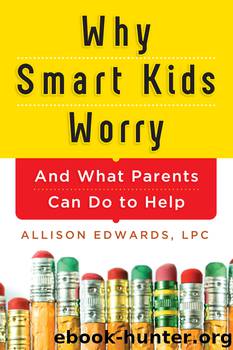
Author:Allison Edwards
Language: eng
Format: epub
Publisher: Sourcebooks, Inc.
Published: 2013-05-05T16:00:00+00:00
7
How to Answer “Is Global Warming Real? When Will I Die? Can a Tornado Hit Our House?” …and Other Tough Questions
As a parent, you don’t have to answer all of your child’s questions. You are not required to answer them, nor are you necessarily going to make a tough situation better if you do. “Mommy, when will I die?” is a question kids will ask. “Uh…well…we just…uh…” is all many parents can come up with. Kids will throw you off, so it’s important to understand why kids ask questions in the first place and how you can give appropriate answers to even the toughest questions.
Why Kids Ask Questions
“Can I have another snack?” “What time are we leaving?” “I’m hungry. When is dinner?” “Can I go outside?” These are the questions kids ask day after day, for years on end. Why? Because kids are constantly needing permission. Because they’re kids, they can’t cook their own dinner, make their own cookies, or cross the street alone. They need their parent to “okay” everything they do.
Kids also ask questions about abstract things that pique their interest. The questions can be about world events, adult issues, or concepts that seem completely random. For example, “Can dinosaurs come back on the Earth? What if all the mummies in Egypt woke up? Will I see Grandma when I die? If God made everything, who made God?” These questions come out of the blue and are the most difficult for parents to answer.
There are three main reasons why kids ask these kinds of questions:
1. They are curious.
2. They don’t understand something.
3. They are seeking comfort.
Kids are curious. With their ever-expanding brains, kids are constantly taking in new information. They are learning how the world works and turn to you for answers. They want to know why the grass is green, why daddy long-legs spiders don’t bite, and why the Earth is round. Kids fall into a pattern of asking questions because they’re continually in the role of not knowing something. At school, the teacher knows the answers. At home, parents know the answers. Kids become dependent on the adults in their lives to tell them what to do and how things work.
In my office, I have shelves of miniatures. When I first start seeing kids, many of them will pick up a very recognizable miniature and ask me what it is. For example, a child will pick up a dog and ask, “What’s this?” When I say, “It can be whatever you want it to be,” the child says, “It’s a dog,” and moves on. The child didn’t need me to tell him what it was. In fact, what he needed was for me not to tell him what it was. He needed to make his own decision. That simple question/answer sequence was the first step in helping him become more independent.
Other kids will immediately ask for help rather than trying something on their own. If they’re playing in the sand, they will hand me the bucket and ask me to make the sand castle.
Download
This site does not store any files on its server. We only index and link to content provided by other sites. Please contact the content providers to delete copyright contents if any and email us, we'll remove relevant links or contents immediately.
The Lost Art of Listening by Michael P. Nichols(7506)
Rich Dad Poor Dad by Robert T. Kiyosaki(6632)
We Need to Talk by Celeste Headlee(5615)
I Love You But I Don't Trust You by Mira Kirshenbaum(3876)
The Complete Idiot's Guide to Coping With Difficult People by Arlene Uhl(3149)
Rich Dad Poor Dad: What The Rich Teach Their Kids About Money - That The Poor And Middle Class Do Not! by Robert T. Kiyosaki(2958)
A Burst of Light by Audre Lorde(2607)
The Book You Wish Your Parents Had Read (and Your Children Will Be Glad That You Did) by Philippa Perry(2528)
Dealing with People You Can't Stand by Dr. Rick Brinkman(2460)
Life Hacks by Dan Marshall(2456)
An Odyssey by Daniel Mendelsohn(2307)
The Expectant Father by Armin A. Brott & Jennifer Ash(2273)
Teach Your Child How to Think by Edward De Bono(2159)
No Time to Say Goodbye(2117)
What I Need by J. Daniels(2081)
The 7 Habits Of Highly Effective Teens by Covey Sean(2080)
The Out-of-Sync Child by Carol Stock Kranowitz(2054)
The Anxious Generation by Jonathan Haidt(2050)
I Don't Belong to You by Keke Palmer(2005)
